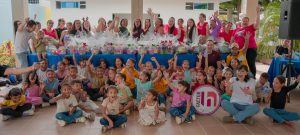
It is exciting to see the joy and willingness with which our volunteers and community service go to the health activities we organize in both Barranquitas and San Luis, which Factor-H and Habitat LUZ organize quarterly to care for the families afflicted with, or at-risk for, Huntington’s disease. So, when we issue the call “all on board,” the bus trip to Barranquitas becomes pleasant despite the difficulties of the road and the four hours it takes to get there.
On April 27, 2024, the first massive medical activity of 2024 was carried out in Barranquitas, during which were treated a total of 21 people with symptomatic Huntington’s disease (HD), 4 people with HD who are bedridden (we go to their homes instead of meeting them at the athletic field where the larger medical activity takes place), and 31 children at-risk for HD. In addition, and for the first time in Barranquitas, a total of 14 adults and 18 children received a dental diagnostic consultation, as well as preventive fluoride treatment.
For this special activity, we counted with the professional assistance of 4 neurologists, 2 pediatricians, 2 pediatric neurologists, 1 physiatrist, 1 general practitioner, 1 pediatric dentist and 10 final-year students of the Faculty of Dentistry, who volunteer for the school’s Community Service program. In addition, the Factor-H/Hábitat LUZ volunteer network, which was organized around this activity, included 35 volunteers of various ages, from Barranquitas and Maracaibo, who managed all the logistics, general control, the pharmacy, blood pressure measurements, height and weight recording, as well as support for each of the specialists to keep a record of the patients and their prescriptions.
It is important t0 emphasize that these types of activities are always based on our guiding principle of providing respectful, personalized care with a high degree of organization so that the patient is treated as soon as possible.
Official health care in Venezuela is extremely precarious and, despite the efforts of the many professionals dedicated to this work, it is usually limited only to diagnosis, and not follow-up care, due to the scarcity of neurological medications. But a consultation for a sick person who does not have the resources to buy medications only solves part of the problem. Therefore, our commitment is to bring each of our patients and children at risk the opportunity for specialized, dedicated and humane care through these large community-directed activities, and also to provide medications whenever possible.
Support for medications is urgent for our Venezuelan patients. Therefore, with the aim of improving their basic quality of life conditions during the disease process, we want to send to everyone who reads these lines an S.O.S with our request for support to Factor-H, so that we can provide with a constant treatment and relief to those patients who are in poverty and extreme poverty and who are registered in our program.
I would not like to end this without mentioning that when we go “on board” the bus that takes us to our destination, we always go with faith and the hope that possibilities and opportunities will continue to open up along the path we travel together.
When we return home, we are tired from the effort and the long day in the relentless sun, but recharged with the emotion that represents the gratitude of those we benefit with our labor of love and professionalism.
Diagnóstico y Manejo de la Enfermedad de Huntington 2016, una Guía Clínica Auspiciada por la Agrupación Chilena de Huntington que Factor-H recomienda.
La guía, que agradece la colaboración en su elaboración a la Dra. Cristina Sampaio -CHDI Foundation Inc.-, también señala el apoyo mientos por el permanente apoyo de la Dra. Claudia Perandones y del Dr. Ignacio Muñoz-Sanjuan en el apoyo de la iniciativa.
“El sentido de ésta guía es abordar la problemática de salud que viven todas las familias portadoras sintomáticas y no sintomáticos de Enfermedad de Huntington, que requieran el dg y manejo adecuado por profesionales competentes, tener al alcance tratamiento sintomático que han demostrado impactar efectivamente en la calidad de vida de los pacientes con Huntington y sus familias.Esta guía está sujeta a cambios conforme el avance del conocimiento científico, la tecnología disponible y según evolucione las áreas de salud en atención.El sentido de esta guía es entregar recomendaciones acerca del diagnóstico y manejo terapéutico y de rehabilitación, en algunos casos las recomendaciones no estará avalada por evidencia científica, pero sí, por la experiencia de un grupo de expertos en el manejo de enfermedad de Huntington, sin embargo la no existencia de evidencia en ciertos aspectos no justifica limitar la utilización de un procedimiento o el aporte de recursos.” (Cochrane)
Gracias al CETRAM por el permiso de hacer esta guía disponible a través de Factor-H
HDBuzz (eng) https://en.hdbuzz.net